
If you are asking, “what type of grass do I have,” the quickest reliable answer comes from looking at several features together: blade width, tip shape, color, growth habit, and the small structures where the blade meets the stem. A single feature, such as a dark green color or a wide blade, is rarely enough for a confident identification.
Knowing your lawn grass matters because mowing height, fertilizer timing, watering needs, weed control options, and overseeding plans can all depend on the species. A lawn may also contain more than one grass type, especially in older yards, repaired areas, and lawns that have been overseeded over time.
This guide explains how to identify common U.S. turfgrasses without relying on guesswork. Start with the broad categories, inspect a few healthy samples closely, and compare the traits you find rather than trying to identify a grass from one leaf alone.
Start by Separating Cool-Season and Warm-Season Grass
The first step in figuring out what type of lawn grass you have is deciding whether it is cool-season or warm-season turf. This does not identify the exact species, but it narrows the list substantially.
| Feature | Cool-Season Grasses | Warm-Season Grasses |
|---|---|---|
| Best growing weather | Spring and fall, with moderate temperatures | Late spring through summer, with sustained warmth |
| Winter appearance | Usually stay green where winters are not too severe | Often turn tan or brown after dormancy in cold weather |
| Summer behavior | May slow down, thin, or go partly dormant during heat and drought | Usually grow most actively in summer heat |
| Common U.S. regions | Northern states, higher elevations, and transition-zone lawns | Southern states, warmer transition-zone areas, and coastal regions |
| Common examples | Kentucky bluegrass, fescues, perennial ryegrass | Bermudagrass, zoysiagrass, St. Augustinegrass, centipedegrass |
Cool-season grasses dominate lawns in much of the Northeast, Midwest, Pacific Northwest, and northern Great Plains. Warm-season turf is common across the Southeast, Gulf Coast, Southwest, and lower elevations of the southern United States. The transition zone, which includes parts of the Mid-Atlantic and lower Midwest, can support either category depending on the yard and grass variety.
Seasonal color is a useful clue, but it is not proof. Drought, shade, disease, poor drainage, and lack of nutrients can also make grass turn brown. Likewise, some southern lawns are overseeded with cool-season ryegrass for winter color, so green grass in January does not always mean the permanent lawn is cool-season turf.
Collect a Good Grass Sample Before You Identify It
Do not try to identify turf from a distant view of the lawn. Take several samples from healthy areas that represent most of the yard. Avoid looking only at thin, diseased, heavily shaded, recently fertilized, or drought-stressed spots, since stressed grass often looks different from normal growth.
- Choose three to five representative locations in the lawn.
- Pull or dig up small plants gently so you keep the leaves, stems, and roots connected.
- Rinse loose soil away if necessary, especially around the crown and lower stem.
- Examine a mature blade, not the newest tiny leaf in the center of the plant.
- Use good daylight and a magnifying glass or phone camera zoom to inspect small features.
For the most dependable result, inspect a living sample before mowing. Freshly cut grass tips lose one of the most useful identification clues: the natural shape of the leaf tip.
Learn the Grass Features That Matter Most
When homeowners wonder, “what type grass do I have,” they often compare color and blade width only. Those traits help, but the small details at the base of a leaf usually provide better evidence.
Blade width, texture, and color
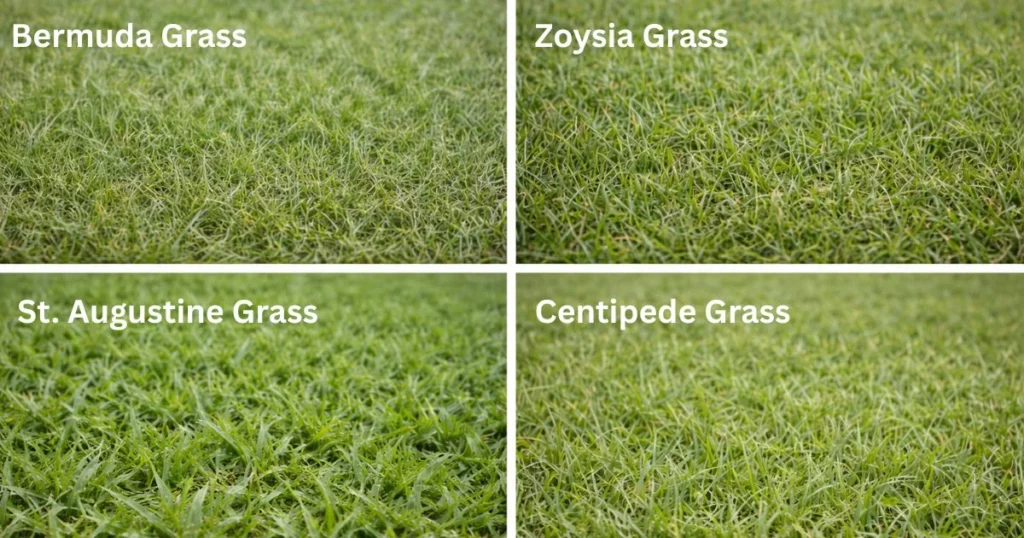
Blade width gives a useful first impression. Fine fescues and bermudagrass have narrow, delicate blades. Tall fescue, St. Augustinegrass, and bahiagrass have noticeably wider, coarser leaves. Zoysiagrass is often medium to fine in width but can feel stiff and bristly.
Color varies with weather, fertility, soil conditions, and cultivar, so treat it as a supporting trait. Kentucky bluegrass is often described as blue-green. Centipedegrass commonly has a lighter, apple-green appearance. Bermudagrass can be gray-green, while St. Augustinegrass is frequently medium to dark green. A fertilizer application can make nearly any grass look greener for a while.
Leaf tip shape
Look at an uncut blade tip. Kentucky bluegrass has a distinctive boat-shaped tip, with the end folded like the bow of a small boat. Perennial ryegrass, tall fescue, and many warm-season grasses tend to have more pointed tips.
This feature is especially valuable when separating Kentucky bluegrass from other cool-season grasses. However, mower damage, foot traffic, and insect feeding can shred or blunt tips, so examine several intact blades.
Vernation: folded or rolled new leaves
Vernation describes how a new leaf sits inside the sheath before it opens. It is either folded or rolled. To check it, gently split the lower leaf sheath or look closely at a young emerging leaf near the crown.
- Folded vernation: Kentucky bluegrass, perennial ryegrass, tall fescue, fine fescue, St. Augustinegrass, and zoysiagrass.
- Rolled vernation: Bermudagrass and centipedegrass are commonly identified this way.
Vernation is easier to see with a hand lens and a fresh sample. It should not be your only identification method, but it can rule out some look-alikes.
Ligule and auricles
The ligule is a small flap, fringe, or membrane where the leaf blade joins the sheath. Auricles are small, claw-like appendages that may wrap around the stem at that same junction. These structures are among the best ways to tell cool-season turfgrasses apart.
- Perennial ryegrass: short, clasping auricles and a short membranous ligule.
- Tall fescue: very small auricles and a short ligule.
- Kentucky bluegrass: no auricles and a short ligule.
- Fine fescue: no auricles and a very short or nearly invisible ligule.
Auricles can be tiny, so do not assume they are absent until you inspect a clean sample closely. A magnified phone photo often makes the comparison easier.
Growth habit: bunches, runners, and spreading stems
Turn the sample over and look at how plants connect and spread. Turfgrass can grow as a bunch, through above-ground runners called stolons, through underground stems called rhizomes, or through a combination of these habits.
- Bunch-type grasses: grow in clumps and do not spread aggressively into bare spots. Tall fescue and perennial ryegrass are common examples.
- Rhizomatous grasses: spread below the soil surface. Kentucky bluegrass is a familiar cool-season example.
- Stoloniferous grasses: spread with visible runners along the soil surface. St. Augustinegrass and centipedegrass commonly do this.
- Rhizomes and stolons: bermudagrass and zoysiagrass can spread both above and below ground, helping them recover from traffic and fill open areas.
Growth habit has practical value. A bunch grass may need overseeding to repair a thin area, while an actively growing spreading grass may eventually fill minor bare spots on its own if the underlying soil, light, and watering problems are corrected.
Identify Common Cool-Season Lawn Grasses
Cool-season turf is often a blend rather than a single species. A bag of seed may contain several grasses because each one brings a different strength, such as drought tolerance, fast establishment, shade performance, or ability to repair damage.
Credit: lawnvista.com
Kentucky bluegrass
Kentucky bluegrass has medium-fine blades, a blue-green cast, folded vernation, and a leaf tip shaped like a boat. It spreads through rhizomes, which can create a dense lawn and help it repair small damaged areas.
It is common in northern lawns with adequate sun and moisture. Kentucky bluegrass may struggle in deep shade, prolonged heat, or drought without irrigation. A lawn that appears to grow in connected patches rather than isolated clumps may contain Kentucky bluegrass, although some blends also include bunch grasses.
Perennial ryegrass
Perennial ryegrass is usually medium-fine textured, dark green, and bunch-forming. Its leaf blades often have a noticeable sheen on the underside, while the upper surface may show distinct veins. Short auricles that clasp the stem are a key identification feature.
This grass germinates quickly and is widely used in cool-season seed mixes. It is also used for temporary winter color in some warm-season lawns. Perennial ryegrass does not spread by rhizomes or stolons, so it normally remains in individual clumps or tufts.
Tall fescue
Tall fescue has wider, coarser blades than Kentucky bluegrass or perennial ryegrass. It grows in bunches, has folded vernation, and generally has a pointed leaf tip. The blades may show pronounced veins, especially on older leaves.
Turf-type tall fescue is common in transition-zone lawns because it can tolerate heat and drought better than many other cool-season grasses. Still, it does not naturally spread as aggressively as Kentucky bluegrass. Thin spots in a tall fescue lawn often need reseeding rather than waiting for runners to fill them.
Fine fescue
Fine fescue is a group that includes creeping red fescue, chewings fescue, hard fescue, and sheep fescue. These grasses have narrow, needle-like blades and a soft, fine texture. Their color can range from medium green to gray-green.
Fine fescues are often included in shade-tolerant mixes and low-input lawns. Some types spread by short rhizomes, while others are bunch-forming. They are less suited to frequent heavy traffic or close mowing than a typical Kentucky bluegrass lawn.
Identify Common Warm-Season Lawn Grasses
Warm-season grasses generally become easier to identify during summer, when they are actively growing. Their dormant winter color can make an entire lawn appear dead even though the grass is healthy and expected to green up when temperatures rise.
Bermudagrass
Bermudagrass has fine to medium-fine blades, pointed tips, and a dense, low-growing habit. It spreads rapidly through both stolons and rhizomes. The above-ground runners are often easy to see at lawn edges, thin areas, or places where mowing is less frequent.
It performs best in full sun and hot weather. Bermudagrass generally thins substantially in shade. Because it spreads aggressively, it can move into flower beds, walkways, and other lawn areas where it is not wanted.
Zoysiagrass
Zoysiagrass forms a dense, carpet-like lawn with medium-fine to medium blades that feel stiff. It spreads by stolons and rhizomes, but usually establishes and fills open areas more slowly than bermudagrass. Its density can help it tolerate moderate foot traffic once established.
Many zoysia lawns turn a uniform straw color during winter dormancy. Zoysiagrass tolerates some shade better than bermudagrass, but it still needs meaningful sunlight to remain dense. Different zoysia varieties can look quite different, so identify the species group before trying to name a cultivar.
St. Augustinegrass
St. Augustinegrass is one of the easiest warm-season grasses to recognize because of its broad, coarse blades and thick, flattened above-ground stolons. The runners often look like sturdy green cords stretching across the soil surface, with leaves emerging at intervals.
It is common in warm, humid, coastal, and southern landscapes. St. Augustinegrass can tolerate more shade than bermudagrass, but it is not a deep-shade grass. It is also more easily damaged by cold than some other warm-season options, so winter injury may occur near the northern edge of its growing range.
Centipedegrass
Centipedegrass has medium-width blades and a lighter green color than many turf types. It spreads with stolons and grows relatively slowly, creating a low-maintenance appearance when planted in the right warm-climate conditions.
It is often found in the Southeast on acidic soils. Centipedegrass can decline when it is overfertilized, repeatedly mowed too short, or grown in unsuitable soil conditions. Its light color is normal and should not automatically be treated as a fertilizer deficiency.
Bahiagrass
Bahiagrass has coarse, tough blades and an open, less carpet-like appearance than bermuda or zoysia. It forms a deep root system and is often used in low-maintenance southern lawns, roadsides, and larger properties. It produces distinctive seedheads shaped like a Y or V when allowed to grow.
Its texture and frequent seedhead production can make it less desirable for homeowners seeking a manicured lawn, but it can be practical in hot, sandy, lower-input sites.
Buffalograss
Buffalograss is a native warm-season grass adapted to dry regions of the central and western Plains. It has fine, curly-looking blue-green blades and spreads by stolons. It usually has a softer, more natural lawn appearance than a highly fertilized, intensively maintained turf.
It is not well suited to constantly wet soil, dense shade, or humid regions where disease pressure is higher. In the right sunny, dry setting, it can be a lower-water alternative to more demanding lawn types.
Use Your Lawn’s Behavior as Supporting Evidence
Once you have looked at the plant itself, consider how the lawn behaves throughout the year. Seasonal patterns, sunlight response, and recovery after wear can support your identification.
- Spreads quickly into cracks and beds: Bermudagrass is a likely possibility, though other stolon-forming grasses can also creep outward.
- Forms distinct clumps in thin areas: Tall fescue or perennial ryegrass may be present.
- Stays greener in winter but struggles in hot summer weather: A cool-season grass is likely.
- Turns tan after frost and greens up late in spring: A warm-season grass is likely.
- Thins severely under trees but performs well in open sun: Many grasses can do this, but bermudagrass is especially shade-sensitive.
- Has wide blades and thick runners: St. Augustinegrass is a strong candidate in suitable southern climates.
Remember that lawn behavior can be changed by irrigation, shade from mature trees, compacted soil, mowing practices, and the presence of multiple grass species. Use these observations to confirm plant traits, not replace them.
Credit: wikihow.com
How to Check Whether Your Lawn Is a Mix
Many homeowners do not have just one turfgrass. Northern lawns commonly contain a blend of Kentucky bluegrass, perennial ryegrass, and fescues. A lawn may also have patches of different grass because of renovations, sod repairs, past owners, or changing light conditions.
Look for consistent differences in blade width, color, texture, and growth habit. For example, coarse upright clumps scattered through finer turf may be tall fescue growing among Kentucky bluegrass. Bright green patches that grow faster than surrounding warm-season turf in cool weather may be annual or perennial ryegrass.
Separate plants by appearance, then inspect each group individually. Do not assume every unusual patch is a different grass species: weeds, sedges, disease, and fertility differences can also change a lawn’s appearance.
Can a What Type of Grass Do I Have App Identify It?
A what type of grass do I have app can be a useful starting point, particularly when it helps you compare photos with common species. Plant identification apps are better at recognizing broad categories and obvious grasses than distinguishing similar turf varieties from a single overhead lawn photo.
Use an app as a second opinion, not as the final diagnosis. For a better result, photograph:
- The entire lawn from a distance.
- A close view of intact leaf blades.
- The leaf collar area, including the ligule and auricles.
- Runners, rhizomes, or the crown of an uprooted sample.
- Any seedhead, if present.
If an app gives different answers for different photos, that may mean the lawn contains a blend or that the images do not show enough diagnostic detail. Your local Cooperative Extension office, county master gardener program, or a qualified turf professional may be able to help identify a fresh sample, especially before you make a costly renovation or herbicide decision.
Common Grass Identification Mistakes
Identifying grass by color alone
Grass color changes quickly with nitrogen, iron, drought, temperature, disease pressure, and mowing height. Use color only after examining structural characteristics.
Confusing grass with sedge
Sedges are grass-like plants but are not true turfgrasses. Their stems are often triangular rather than round, which is remembered by the phrase “sedges have edges.” Nutsedge commonly grows faster than the lawn and may appear shinier or lighter green. If a plant has a triangular stem, it needs a different control strategy than turfgrass or broadleaf weeds.
Trying to identify freshly mowed clippings
Clippings are difficult to identify because they lack roots, runners, leaf collars, and intact tips. Pull a complete plant from the lawn instead.
Assuming every coarse patch is a weed
Coarse grass may be tall fescue, St. Augustinegrass, bahiagrass, orchardgrass, or another desirable or undesirable species depending on the lawn’s intended turf type. Identify it before treating it.
Choosing treatment before confirming the grass
Herbicide tolerance differs widely among turfgrass species and products. Some weed-control products are safe for one grass type but can injure another. Confirm the lawn species, read the current product label, and consider temperature, drought stress, and nearby desirable plants before applying any lawn chemical.
What to Do After You Identify Your Grass
Once you know what type of lawn grass you have, use that information to tailor care instead of following a generic lawn calendar. Start with the grass category, then refine your plan based on local climate, soil, shade, traffic, and irrigation capacity.
- Cool-season lawns: Most major maintenance, including fertilizing, aeration, and overseeding, is commonly better aligned with active fall growth. Summer care should focus on reducing stress.
- Warm-season lawns: Fertilizer and repair work generally fit the active warm growing season. Avoid encouraging tender growth too late before cold weather.
- Bunch-type lawns: Plan to reseed thin areas when conditions suit the species.
- Spreading lawns: Correct compaction, mowing, sunlight, and watering issues so stolons or rhizomes can fill small gaps.
- Mixed lawns: Choose products and practices that are safe for every desirable grass you want to keep.
If you remain uncertain, avoid making a major change based on a guess. A close sample examination and local identification can prevent problems such as using the wrong mowing height, applying an unsuitable herbicide, or planting seed that clashes with the existing lawn.
:max_bytes(150000):strip_icc():focal(2999x0:3001x2):format(webp)/GettyImages-2225616781-59590082e371452192f8b7ef95e0eb53.jpg)
Credit: thespruce.com
Frequently Asked Questions
Can I identify my lawn grass from a seedhead?
Often, yes. Seedheads can be very helpful because their shape differs among grass species. Bahiagrass commonly produces a Y-shaped seedhead, while bermudagrass typically has several finger-like spikes radiating from one point. Seedheads are not always present, though, especially in regularly mowed lawns.
Why does one section of my lawn look like a different grass?
It may be a different turf species introduced through sod, seed, repairs, or previous lawn work. It could also be the same grass responding differently to shade, compaction, drainage, fertility, or watering coverage. Compare complete plants from both areas before concluding that the species is different.
Is crabgrass the same as bermudagrass?
No. Both can spread outward and have narrow blades, but crabgrass is an annual weed that usually dies after frost, while bermudagrass is a perennial warm-season turfgrass. Crabgrass often has wider, flatter blades and a more open, sprawling growth pattern.
Will grass identification tell me the exact variety or cultivar?
Usually not. Visual inspection can often identify the grass species or group, but named cultivars can look very similar. Exact cultivar identification may require original sod or seed records, specialized testing, or professional turf evaluation.
Should I send a sample to my local Extension office?
That can be worthwhile when you need to make an important lawn-care decision, such as selecting a herbicide, planning a full renovation, or diagnosing a recurring problem. Contact the office first to ask how they prefer samples to be collected and submitted.