
Dandelions in lawn areas are one of the most familiar signs of a thinning or stressed turfgrass stand. Their bright yellow flowers and puffball seed heads are easy to spot, but the plants are more than a cosmetic issue: established dandelions compete with grass for water, nutrients, light, and open soil space.
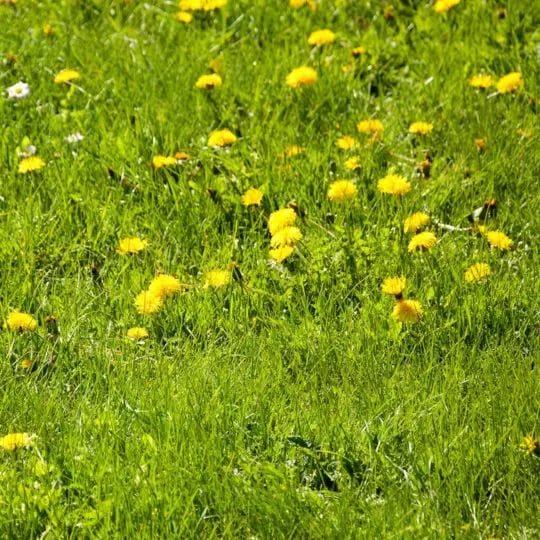
A few dandelions do not automatically mean your lawn is failing. They can grow in healthy turf, especially where seed blows in from nearby yards, roadsides, or unmowed areas. However, a lawn with dandelions throughout usually has conditions that favor broadleaf weeds, such as thin grass, compacted soil, weak mowing habits, or bare spots.
The best way to manage dandelions lawn-wide is to combine removal or targeted treatment with better turf care. Killing visible plants without improving the lawn often leaves open space for new dandelion seeds to germinate.
What Dandelions Are and Why They Spread So Easily
Common dandelion (Taraxacum officinale) is a perennial broadleaf weed. It forms a low, circular rosette of toothed leaves, produces yellow composite flowers, and develops round white seed heads. Each seed is attached to a small parachute-like structure that can travel on the wind.
Dandelions survive well in lawns because they have a deep taproot. Pulling off the leaves or breaking the root near the surface may not kill the plant. If enough of the root remains, it can produce new leaves and continue growing.
The plant’s growth habit also helps it avoid mowing damage. Most leaves sit close to the soil surface, below the mower’s cutting height. Flowers may be removed by mowing, but the plant itself remains alive and may bloom again later.
How to Identify a Dandelion Correctly
Before treating any weed, confirm what it is. Several lawn weeds have yellow flowers, but they may need different management approaches. A true dandelion usually has these features:
- A basal rosette, meaning all leaves emerge from the plant’s center near the soil.
- Deeply lobed leaves with jagged edges that point back toward the center.
- Leafless flower stems that are hollow and contain a milky sap when broken.
- One yellow flower per stem rather than clusters of flowers.
- Round, white seed heads that form after flowering.
- A thick central taproot that grows downward into the soil.
Catsear, hawkweed, sowthistle, and other yellow-flowering weeds can resemble dandelions from a distance. Look closely at the stems and leaves before choosing a herbicide, especially if you are treating a large area.
Why Dandelions Appear in a Lawn
Dandelion seeds can land almost anywhere, so their presence is not always caused by poor maintenance. Still, they establish most easily where grass is not dense enough to shade the soil and compete for resources.
Thin or Bare Turf
Thin turf is the most common reason dandelions become noticeable. Grass may thin because of drought, insects, disease, heavy foot traffic, shade, pet damage, poor drainage, or mowing too short. Once soil is exposed, dandelion seed has a better chance of reaching the ground and germinating.
Warm-season lawns may thin during winter dormancy, while cool-season lawns often struggle during summer heat. The right recovery strategy depends on the grass type and local weather pattern.
Compacted Soil
Dandelions can grow in compacted soil better than many turfgrasses. Compaction reduces the air spaces that grass roots need for water movement, oxygen, and root growth. It is common near driveways, play areas, gates, sidewalks, and other high-traffic zones.
A dandelion’s taproot can work through soil that limits the finer root systems of turfgrass. A few dandelions do not prove that compaction is present, but a recurring patch in a heavily used area is worth investigating.
Mowing Too Low
Scalping a lawn weakens grass by removing too much leaf tissue at once. The grass then has less energy to grow roots, recover from heat, and compete with weeds. Dandelions, with their low-growing rosettes, gain an advantage.
Follow the recommended mowing height for your grass species and avoid removing more than about one-third of the grass blade in a single mowing. Taller, properly maintained turf generally shades the soil better and discourages many broadleaf weeds.
Inconsistent Watering and Nutrient Stress
Grass stressed by long dry periods, shallow frequent watering, or unsuitable fertilization may lose density. Dandelions are adaptable and may remain green and noticeable after nearby grass weakens.
Water deeply enough to encourage deeper grass roots, adjusting for rainfall, soil type, temperature, and local restrictions. Fertilize based on your grass type, season, and ideally a soil test rather than applying fertilizer simply because weeds are present.
Seed Sources Nearby
Dandelion seed can blow into a yard from neighboring lawns, vacant lots, fields, and roadside areas. Even an excellent lawn can receive new seed every year. The goal is not always to create a permanently seed-free property; it is to keep turf dense enough that most seeds do not establish.
Are Dandelions Bad for Your Yard?
Dandelions are not inherently dangerous to a lawn, and a small number may be acceptable in a low-maintenance or pollinator-friendly yard. Their flowers can provide an early-season food source for insects, though they are not a replacement for a diverse selection of native flowering plants.
In a managed turf lawn, however, a large dandelion population can be a practical problem. The plants compete with grass and produce abundant seed. Their broad leaves also interrupt the even appearance and texture many homeowners want from a lawn.
| Situation | Best General Approach |
|---|---|
| A few isolated plants in otherwise thick grass | Hand-pull or spot-treat, then monitor for new seedlings. |
| Many plants across a thin lawn | Improve turf density and use targeted control where needed. |
| Dandelions in a pollinator-focused or naturalized area | Decide on an acceptable level of weeds and avoid broad treatment unless necessary. |
| Recurring dandelions in one compacted area | Address traffic, soil compaction, drainage, and turf recovery. |
Dandelions are also edible, but lawn plants should not be harvested for food if the area may have been treated with herbicides, pesticides, or other chemicals, or if it is exposed to pet waste, roadside contamination, or other pollutants.
Credit: diypestcontrol.com
When to Control Dandelions in Lawn Areas
Timing matters because dandelions move energy between their leaves and roots at different times of year. The best control window depends on the method you use and your local climate.
Hand Removal Timing
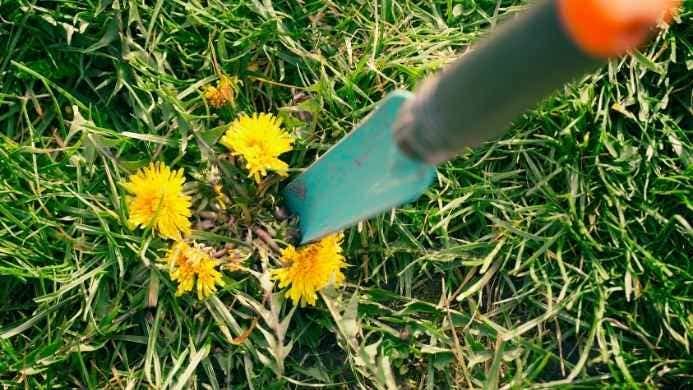
Hand-pulling is easiest when soil is moist but not muddy, often after steady rainfall or irrigation. A long-rooted weeding tool can help loosen soil around the taproot. Removing plants before their seed heads mature reduces the number of seeds released into the lawn.
You can pull dandelions whenever the ground is workable, but young plants are much easier to remove than large, well-established ones.
Herbicide Timing
For selective broadleaf herbicides, fall is often an effective time to treat perennial dandelions. As plants prepare for cooler weather, they move stored energy into their roots, which can help systemic products reach the root system. Spring treatment can also work, particularly when weeds are actively growing, but it may require follow-up control.
Do not apply herbicide to drought-stressed, heat-stressed, frozen, or newly seeded turf unless the product label specifically permits it. Avoid mowing immediately before or after application if the label calls for enough leaf area and contact time. Product instructions vary, so the current label is the authority for grass compatibility, weather conditions, rates, and reseeding intervals.
How to Get Rid of Dandelions Without Damaging Grass
The right method depends on how many dandelions you have, whether you want to avoid herbicides, and the condition of the lawn. For scattered weeds, physical removal is often the simplest choice. For widespread infestations, a selective product and lawn renovation plan may be more realistic.
Hand-Pull Individual Dandelions
Hand removal is effective when you remove as much of the taproot as possible. It works especially well for a few plants in a lawn that is otherwise healthy.
- Water the area lightly or wait until the soil is moist.
- Use a dandelion digger, hori-hori knife, narrow trowel, or similar tool to loosen soil beside the root.
- Grip the crown of the plant close to the soil line.
- Pull slowly while lifting and loosening the root rather than yanking the leaves.
- Fill the hole with soil and press it lightly to reduce exposed bare ground.
- Seed or encourage nearby grass to fill the opening when timing is suitable for your turf type.
If a root breaks, do not assume the effort failed. Watch the area for regrowth and remove the plant again while it is small. Repeated removal gradually weakens the root.
Use a Selective Broadleaf Herbicide for Larger Infestations
A selective broadleaf lawn herbicide is designed to control certain broadleaf weeds while leaving labeled turfgrass species unharmed. These products are often more appropriate than nonselective herbicides for a lawn with dandelions because nonselective products can kill grass as well as weeds.
Read the entire product label before buying or applying anything. Confirm that the product is labeled for your grass species and for dandelion control. Some turfgrass types, especially certain warm-season varieties, can be more sensitive to particular active ingredients or application conditions.
- Apply only at the labeled rate and during suitable weather.
- Do not treat when wind could carry spray onto gardens, trees, shrubs, vegetables, or desirable flowers.
- Keep children and pets away until the label’s re-entry instructions are met.
- Do not apply near ponds, streams, drains, or wells unless the label specifically allows that use and you can prevent runoff.
- Use spot treatment when possible instead of spraying an entire lawn for scattered weeds.
- Check local rules, as some communities restrict certain herbicide uses.
Do not mix products or add extra surfactants, fertilizers, or other materials unless the label specifically permits it. More product does not mean better control and can injure turf, contaminate runoff, or create avoidable exposure risks.
Avoid Homemade Weed Killers in Turf
Vinegar, salt, boiling water, and similar home remedies may burn dandelion leaves, but they can also damage grass and soil. Salt is particularly problematic because it can persist in the soil and prevent plants from growing properly. These methods are not good choices for dandelions growing in an established lawn.
Boiling water can be useful only in a hardscape crack or another area where you want no vegetation at all. It should not be used around turf, ornamental plants, or tree roots.
Repair the Conditions That Favor Dandelions
Removing dandelions is only half the job. The long-term solution is a thicker, healthier lawn that leaves fewer openings for weed seed to establish.
:max_bytes(150000):strip_icc()/get-rid-of-dandelions-naturally-dig-1fe2826ac82a446e94ee8c53287d9e93.jpg)
Credit: thespruce.com
Mow for Dense, Resilient Turf
Keep the mower blade sharp and mow at the recommended height range for your grass type. Dull blades tear grass, causing ragged tips that can make the lawn look dull and stressed. Avoid cutting very short just before summer heat or drought, when grass needs leaf area to support its roots.
Leave short clippings on the lawn when they do not form heavy clumps. They return some nutrients and organic matter to the soil, though they are not a substitute for correcting genuine soil nutrient deficiencies.
Water Deeply and Adjust to Conditions
Established lawns generally perform better with less frequent, deeper watering than with daily light sprinkling. The correct amount and frequency depend on rainfall, temperature, soil texture, slope, grass species, and sprinkler coverage.
Clay soil may absorb water slowly and can shed water on slopes if irrigation runs too long at once. Sandy soil drains quickly and may need a different approach. If water runs off before it soaks in, use shorter irrigation cycles with breaks between them rather than applying more water all at once.
Feed the Lawn Based on Its Needs
Fertilizer can help turf fill in, but excessive or poorly timed fertilization can create its own problems. Cool-season grasses are often fertilized most effectively during their strongest growth periods, while warm-season grasses are typically fed during active warm-weather growth. Local Cooperative Extension guidance and a soil test can help you choose an appropriate program.
Never use fertilizer as a substitute for correcting shade, compaction, drainage, insect damage, or poor mowing practices. Grass will not thicken reliably if its growing conditions are fundamentally unsuitable.
Relieve Compaction When Appropriate
Core aeration can help improve water infiltration and root growth in compacted lawns. It is most useful when grass is actively growing and has time to recover. Cool-season turf is commonly aerated in the late summer to early fall in many regions, while warm-season turf is generally aerated during active late-spring or summer growth.
Do not aerate simply because dandelions are present. First look for signs such as hard soil, standing water, poor infiltration, worn traffic paths, and weak grass despite reasonable care.
Overseed or Repair Thin Areas at the Right Time
Overseeding is a useful strategy for many cool-season lawns, especially where turf has thinned from summer stress. Warm-season lawns are more often repaired with plugs, sprigs, sod, or species-specific establishment methods, although some situations differ.
Plan weed control and seeding together. Many herbicides have waiting periods before seeding or after seeding. Follow the label carefully so you do not reduce grass establishment or injure new seedlings.
Common Mistakes When Managing Dandelions in Yard Areas
- Only mowing flowers: Mowing may reduce seed heads temporarily, but it does not remove the taproot or solve the cause of infestation.
- Pulling leaves without loosening the root: The leaves can detach while the plant survives underground.
- Spraying every weed without identification: Similar-looking plants may require different approaches, and unnecessary treatment increases risk to desirable plants.
- Applying herbicide during poor weather: Heat, drought, wind, rain, or cold can reduce effectiveness or increase turf injury risk, depending on the product.
- Ignoring bare spots after removal: Empty soil is an invitation for more weeds. Help grass recover whenever the season and grass type allow.
- Trying to fix every problem with fertilizer: Compaction, shade, drainage issues, and traffic damage need their own solutions.
Credit: greenlawnfertilizing.com
Living With Some Dandelions
Not every homeowner needs a completely weed-free lawn. If dandelions are limited to a small part of the property and do not bother you, hand removal before seed heads form may be enough. You can also reserve a less formal area of the yard for natural growth while maintaining turf more closely near entrances, patios, play spaces, or garden beds.
If supporting pollinators is a priority, consider adding a variety of regionally appropriate native plants to garden beds or a designated meadow area. This approach provides more consistent and diverse food and habitat than relying on dandelions alone, while allowing the main lawn to remain easier to manage.
Frequently Asked Questions
Can dandelions come back after being pulled?
Yes. If part of the taproot remains in the soil, the plant may regrow. New plants can also appear from windblown seed. Check pulled areas periodically and remove any regrowth while it is still small.
Should I remove dandelion seed heads before mowing?
If practical, removing mature white seed heads before they disperse can reduce local seed spread. However, mowing regularly before flowers mature is usually more realistic for most lawns. It will not eliminate existing plants, but it can limit some seed production.
Will a thick lawn prevent every dandelion?
No lawn can block every incoming seed. Dense, healthy turf makes establishment much less likely by shading the soil and competing for water and nutrients. Occasional spot removal is still normal.
Are dandelions worse in spring or fall?
Dandelions are often most visible in spring because of their bright blooms, but fall can be an important management period for established perennial plants. The best timing depends on whether you are pulling plants, applying a labeled herbicide, or repairing thin turf.
Can I compost dandelions removed from my lawn?
You can compost dandelions if your compost system is managed well, but avoid adding mature seed heads to a cool or slow pile where seeds may survive. When in doubt, dispose of flowering or seeding plants according to local yard-waste guidance rather than risking their spread.