
Spring lawn care steps should match your grass type, local weather, and the condition of your yard—not just the calendar. A lawn that is still dormant, soggy, or recovering from winter needs a lighter touch than one that is actively growing.
The goal in spring is to clean up winter damage, encourage healthy roots, prevent seasonal weeds, and prepare the lawn for summer stress. Doing tasks in the right order matters, especially if you plan to use pre-emergent weed control, fertilize, aerate, or seed bare areas.
Use this guide as a practical sequence rather than a rigid schedule. Cool-season lawns in northern states and warm-season lawns in southern states wake up at different times, and rainfall, soil temperature, shade, and grass species can all change the best timing.
Start When the Lawn and Soil Are Ready
One of the most important spring lawn steps is knowing when to begin. Working on frozen, muddy, or saturated soil can compact it and damage emerging grass plants. Wait until the lawn is mostly dry underfoot and the ground has thawed.
Look for these signs before doing heavier work:
- The lawn is no longer covered by snow or standing water.
- Soil does not stick heavily to shoes or equipment tires.
- Grass has started showing signs of growth, if it is a warm-season lawn.
- Daytime temperatures are consistently mild enough for outdoor work.
Cool-season grasses, including Kentucky bluegrass, perennial ryegrass, tall fescue, and fine fescue, often begin growing early in spring. Warm-season grasses such as bermudagrass, zoysiagrass, centipedegrass, St. Augustinegrass, and bahiagrass may remain brown or partly dormant until temperatures rise more reliably.
1. Clean Up Winter Debris Carefully
Begin with a light cleanup. Remove fallen branches, trash, thick leaf layers, pine cones, and other debris that blocks sunlight and traps moisture against the grass. A leaf rake, blower, or lawn sweeper can work well, but avoid aggressive raking when the soil is soft.
Light raking can lift matted grass blades and improve air movement. However, forceful raking can tear out shallow roots, particularly on lawns weakened by winter, drought, or foot traffic.
Check for snow mold and matted turf
After snow melts, some northern lawns develop circular gray, pink, or straw-colored patches called snow mold. The grass may look flattened and matted rather than dead. Gently rake affected areas once they have dried enough to separate the blades and improve airflow.
Many lawns recover as temperatures warm and new growth begins. If patches continue expanding, become severely thinned, or return year after year, a local Cooperative Extension office or lawn professional may help identify the cause. Similar symptoms can also result from poor drainage, pet damage, compaction, or fungal disease.
2. Inspect the Lawn Before Applying Products
Walk the lawn before buying fertilizer, seed, or weed control. This simple inspection helps you avoid treating the wrong problem. Brown grass, thin turf, moss, bare soil, and weeds do not all have the same cause.
Pay attention to:
- Thin or bare areas: These may result from winter injury, shade, dog traffic, grubs, poor soil, or last summer’s heat and drought.
- Standing water: Persistent puddles can point to compacted soil, low spots, blocked drainage, or irrigation leaks.
- Weed types: Broadleaf weeds, grassy weeds, and sedges require different control methods.
- Moss: Moss often thrives where grass struggles because of shade, poor drainage, low soil fertility, compaction, or acidic soil. Killing moss alone does not solve the underlying issue.
- Tree and shrub shade: Grass needs enough direct or filtered light for the species. Thin turf under dense canopies may need a shade-tolerant grass, reduced traffic, or a different landscape approach.
Consider a soil test
A soil test is one of the most useful steps for lawn care in spring, especially if your lawn has recurring problems or you have been applying fertilizer without clear results. A test can reveal soil pH and nutrient levels, helping you choose amendments and fertilizer more accurately.
Many state university Cooperative Extension programs offer soil testing or can direct homeowners to reputable labs. Follow the lab’s sampling instructions, since soil should be collected from several spots rather than a single location. Avoid applying lime, sulfur, or high-phosphorus fertilizer just because it seems like a standard spring task; use test results and local guidance whenever possible.
3. Service Your Mower and Basic Lawn Equipment
A sharp, properly adjusted mower makes a visible difference in lawn health. Dull blades shred grass tips instead of cutting cleanly, leaving a ragged appearance that can increase moisture loss and make turf more vulnerable to stress.
Before regular mowing begins, inspect your equipment according to the manufacturer’s manual. For gas mowers, this may include checking the oil, air filter, spark plug, fuel condition, and blade. Battery mower owners should inspect the battery, charger, deck, wheels, and safety controls.
Before cleaning under a mower deck, clearing packed grass, or handling the blade, shut the mower off, disconnect power or remove the battery when appropriate, allow hot parts to cool, and follow the manufacturer’s safety instructions. If blade removal, balancing, or engine service is outside your comfort level, use a qualified service shop.
Set the mowing height for the grass type
Do not assume every lawn should be cut short in spring. Mowing height depends on the grass species, the amount of shade, and the lawn’s condition. In general, slightly taller grass develops deeper roots, shades the soil, and can compete better with weeds.
Follow the recommended mowing range for your grass type and avoid removing more than roughly one-third of the leaf blade in a single mowing. If the lawn became too tall over winter, lower the height gradually across several mowings rather than scalping it.
Warm-season lawns are sometimes cut shorter during spring cleanup, but only when they are actively coming out of dormancy and the practice suits the specific grass. Scalping too early can expose soil, encourage weeds, and slow recovery after a late cold spell.
4. Manage Early Weeds Before They Take Over
Spring is the key season for preventing many annual grassy weeds, including crabgrass. The best method depends on whether you are protecting an established lawn or trying to establish new grass from seed.

Credit: lawnlove.com
Use pre-emergent herbicide strategically
Pre-emergent herbicides create a barrier that stops certain weed seeds from establishing. They are often used before summer annual weeds germinate, but timing varies by region and weather. Soil temperature, not a single nationwide date, is a better guide.
The major trade-off is that many pre-emergent products can also prevent desirable grass seed from germinating. If you intend to seed or overseed an area this spring, read the product label closely before applying any pre-emergent herbicide. The label will state where it can be used and how long to wait before seeding.
Remove visible weeds when practical
Hand-pulling small weed populations is often effective when soil is moist and the entire root can be removed. A dandelion digger or narrow hand weeder helps with tap-rooted weeds. Mow before weeds produce seed heads, but remember that mowing alone usually does not eliminate perennial weeds.
For larger infestations, identify the weed before choosing a selective herbicide. A product safe for one turfgrass may injure another, and some products should not be used near desirable plants, vegetable gardens, waterways, or tree root zones. Always follow the current product label, including application conditions and precautions for children, pets, pollinators, and nearby plants.
5. Fertilize Only When the Lawn Can Use It
Spring fertilizer can support healthy growth, but applying it too early or too heavily can create weak, fast top growth and increase mowing demands. The best fertilizer timing differs between cool-season and warm-season lawns.
| Grass type | General spring approach | What to avoid |
|---|---|---|
| Cool-season grass | Use a modest application if the lawn needs it and soil conditions support growth. Base nutrient choices on a soil test when possible. | Heavy nitrogen applications that push excessive spring growth and may leave the lawn less prepared for summer heat. |
| Warm-season grass | Wait until the lawn has greened up and is actively growing before applying nitrogen fertilizer. | Fertilizing dormant or only partly green turf, especially when late cold weather remains possible. |
Choose a fertilizer based on your soil test, grass type, and local regulations. Some states or municipalities limit phosphorus use in lawn fertilizers unless a soil test shows a need or the lawn is newly established. Sweep spilled fertilizer off driveways and sidewalks, and keep it out of storm drains and waterways.
Slow-release nitrogen products can provide more gradual feeding, but no fertilizer replaces proper mowing, watering, sunlight, and soil conditions. If the lawn is thin because of shade, compaction, disease, or poor drainage, fertilizer alone will not correct the problem.
6. Aerate or Dethatch Only When There Is a Clear Need
Aeration and dethatching are useful tools, but they are not mandatory annual spring chores. Both can stress turf when done at the wrong time or too aggressively.
When core aeration helps
Core aeration removes small plugs of soil to improve air, water, and nutrient movement around the roots. It can be helpful when the soil is compacted from heavy traffic, construction activity, clay content, or repeated equipment use.
Signs of compaction may include hard soil, poor water infiltration, shallow roots, puddling, and thinning grass in high-traffic areas. A screwdriver that is difficult to push into moist soil can also suggest compaction, although soil moisture and rocks can affect the result.
For cool-season lawns, early fall is often the best time for major core aeration because grass has time to recover in favorable growing weather. Spring aeration can still be reasonable for a compacted lawn, but it may bring buried weed seeds to the surface. Warm-season grasses are generally aerated after they are fully green and actively growing.
When dethatching is appropriate
Thatch is the layer of living and dead stems, roots, and other organic material between the green grass blades and soil. A thin layer can be normal. Excessive thatch may prevent water from reaching the soil and can make the lawn feel spongy.
Do not confuse thatch with grass clippings. Properly mowed clippings break down quickly and usually do not create damaging thatch. Before power raking or using a dethatcher, check the layer beneath the turf. If it is not unusually thick or dense, aggressive dethatching may do more harm than good.
Warm-season grasses that produce heavy runners may benefit from occasional dethatching during active growth. Cool-season lawns should be dethatched cautiously, preferably when they can recover quickly. If you are unsure whether the issue is thatch, compaction, or poor soil, start with a close inspection rather than renting equipment immediately.
7. Repair Bare Spots With the Right Plan
Spring seeding can improve small bare patches in cool-season lawns, but it is not always the ideal time for a full renovation. Summer heat and weed pressure make it harder for young cool-season grass to establish. Late summer to early fall is usually more favorable for major cool-season seeding projects.
Still, spring repairs can be worthwhile when bare soil would otherwise invite weeds and erosion. Match the seed to the existing lawn when possible, prepare the soil surface, and keep the seedbed consistently moist until seedlings establish. Use a light covering of clean straw or an appropriate seed-starting mulch only if needed to reduce washout and drying.
Warm-season lawns are commonly repaired with plugs, sod, sprigs, or seed depending on the grass species. Many warm-season grasses are not typically established from seed, so verify the best method for your particular turf before purchasing materials.

Credit: searshomeservices.com
Do not combine seeding with incompatible weed control
This is one of the most common spring lawn care mistakes. Pre-emergent herbicides may interfere with seed germination, while some post-emergent weed products can injure young grass seedlings. Plan the sequence before applying either seed or herbicide, and use the product label as the final authority on waiting periods and turf compatibility.
8. Water for Roots, Not Just Green Color
Spring rain may provide much of the moisture an established lawn needs, but rainfall is uneven. Check the soil rather than watering automatically. Turf that is actively growing generally benefits from deeper, less frequent watering than frequent shallow sprinkling, because deeper watering encourages roots to grow farther into the soil.
Adjust watering for soil texture, slope, shade, wind, rainfall, and local restrictions. Sandy soil drains quickly and may need water applied in shorter cycles. Clay soil may shed water or develop runoff if irrigation is applied too quickly. On slopes, cycle-and-soak watering can help water infiltrate instead of flowing into sidewalks or storm drains.
New seed, sod, plugs, and recently transplanted plants need different moisture management than established turf. Their roots are shallow and should not be allowed to dry out during establishment. Once rooted, gradually transition them to a deeper watering pattern.
9. Build a Consistent Mowing Routine
Once spring growth picks up, mowing becomes one of the strongest tools for maintaining a dense lawn. Regular mowing encourages many turfgrasses to spread and fill in, while overly infrequent mowing can weaken the lawn by forcing you to remove too much growth at once.
- Mow when the grass is dry enough to cut cleanly.
- Keep mower blades sharp.
- Change mowing direction occasionally to reduce wheel rutting and grass leaning.
- Leave short, dry clippings on the lawn when practical; they return nutrients to the soil.
- Bag clumps of wet or overly long clippings that could smother the grass.
Avoid mowing during a frost event or when the lawn is waterlogged. Also keep heavy equipment off soft areas near drainage problems, septic components, or newly seeded ground.
10. Watch for Problems as the Season Changes
Spring conditions can reveal underlying lawn issues, but it is important not to diagnose every brown patch as insects or disease. Observe the pattern, location, and timing before treating.
For example, irregular dry areas may be caused by sprinkler coverage problems, compacted soil, shallow roots, or tree competition. Circular patches may suggest a disease issue, but they can also result from pet urine, fertilizer spills, mower turns, or different grass varieties. Insects should be confirmed before using an insecticide, since unnecessary treatment can harm beneficial organisms and may not solve the problem.
If an issue is spreading quickly, affecting a large part of the lawn, or repeatedly returning, take clear photos and contact your local Cooperative Extension office, a qualified lawn professional, or an arborist when tree-root competition is involved. Accurate identification is usually more valuable than applying multiple products at random.
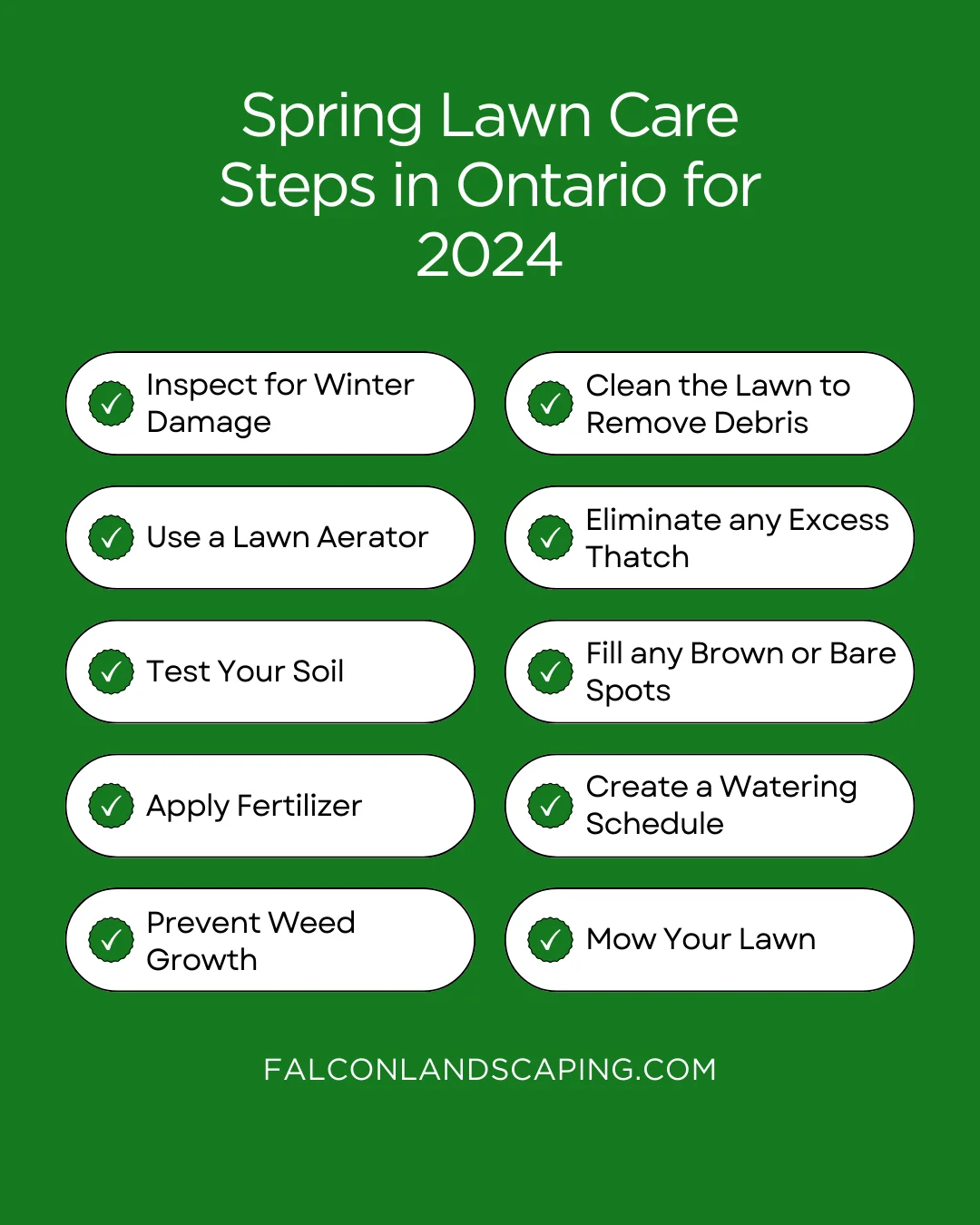
Credit: falconslandscaping.com
Frequently Asked Questions
Should I rake my lawn as soon as the snow melts?
Wait until the lawn is reasonably dry and the soil is firm enough to walk on without leaving deep impressions. Early light raking is useful for removing debris and lifting matted grass, but aggressive raking on wet ground can pull out grass plants and compact the soil.
Can I apply crabgrass preventer and grass seed on the same day?
Usually, that is not a good combination because many crabgrass preventers also stop turf seed from germinating. Some products have different restrictions, so check the exact label and decide whether weed prevention or lawn establishment is the higher priority for that area.
Why is my lawn green in some places and brown in others during spring?
Uneven spring color can result from differing grass varieties, shade, winter injury, drainage, compacted soil, pet activity, or uneven fertilizer distribution. Give the lawn time to resume growth, then investigate persistent patches rather than assuming the entire yard needs fertilizer.
Is it okay to leave grass clippings on the lawn?
Yes, short clippings from regular mowing are generally beneficial because they break down and return nutrients to the soil. Remove or redistribute thick clumps, especially after mowing damp or overgrown grass, because clumps can block light and smother the turf beneath them.
When should I call a professional for a lawn problem?
Professional help is sensible when large areas are dying, drainage is affecting structures, a tree may be hazardous, pesticide identification is uncertain, or repeated DIY treatments have not worked. A local expert can assess conditions that are difficult to diagnose from surface symptoms alone.