
Lawn fertilizer numbers tell you what nutrients are in the bag and how much of each nutrient the product contains. Understanding them helps you choose a fertilizer that matches your grass, soil, season, and lawn goals instead of applying nutrients your yard does not need.
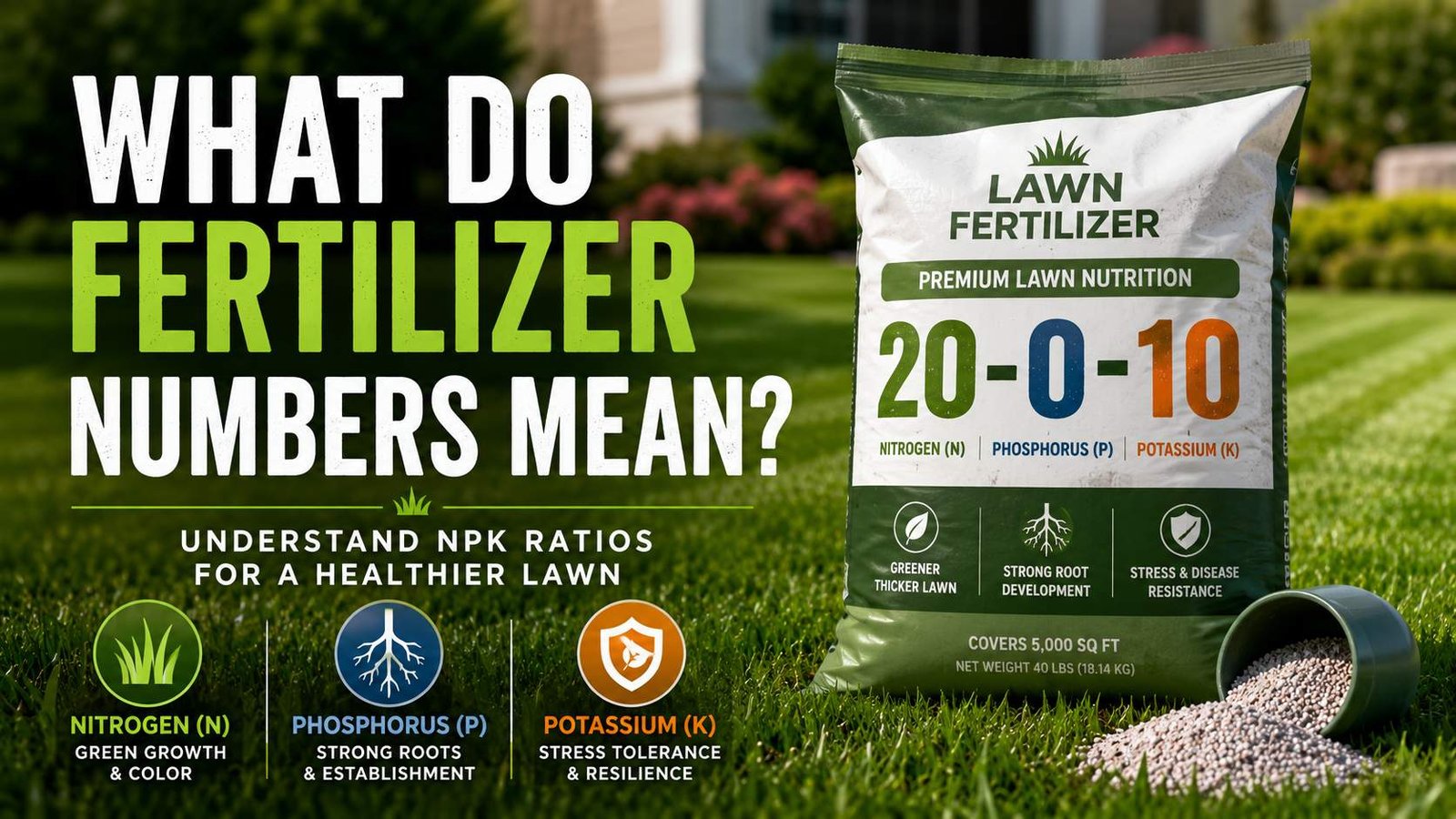
The three numbers printed prominently on most lawn fertilizer bags represent nitrogen, phosphorus, and potassium, in that order. For example, a fertilizer labeled 24-0-6 contains 24% nitrogen, 0% phosphorus, and 6% potassium by weight.
These numbers are useful, but they are only one part of choosing and applying fertilizer correctly. Grass type, active growth, soil conditions, local phosphorus rules, weather, and the product label all matter.
What Lawn Fertilizer Numbers Mean
The numbers on fertilizer are called the guaranteed analysis. They appear as three numbers separated by hyphens, such as 10-10-10, 16-4-8, or 30-0-4.
| Number | Nutrient | Primary role in a lawn |
|---|---|---|
| First | Nitrogen (N) | Supports green color and leafy growth |
| Second | Phosphorus (P) | Supports root development and early plant establishment |
| Third | Potassium (K) | Supports overall plant function and stress tolerance |
The percentages refer to the fertilizer’s total weight. A 40-pound bag of 20-0-5 fertilizer contains 8 pounds of nitrogen and 2 pounds of potassium. The remaining weight consists of carrier materials, coatings, fillers, and sometimes other nutrients.
Importantly, a higher first number does not automatically mean a fertilizer is better. It simply means the product is more concentrated in nitrogen. A concentrated fertilizer may require less product per 1,000 square feet, but the correct application rate still depends on the label and your lawn’s needs.
The Role of Nitrogen, Phosphorus, and Potassium
Nitrogen: the first number
Nitrogen is usually the nutrient that most directly affects a lawn’s color and growth rate. It helps grass produce chlorophyll, the pigment responsible for green leaves, and supports vigorous top growth.
A nitrogen-containing fertilizer can be useful when turf is actively growing and needs nutrients. However, excessive nitrogen can cause problems, including rapid mowing growth, weak succulent growth, increased disease risk in some conditions, fertilizer burn, and nutrient runoff.
Grass does not need the same amount of nitrogen all year. Cool-season grasses such as Kentucky bluegrass, perennial ryegrass, tall fescue, and fine fescue generally have their strongest growth periods in spring and fall. Warm-season grasses such as bermudagrass, zoysiagrass, St. Augustinegrass, centipedegrass, and bahiagrass respond best to fertilization during their warm, active growing season.
Phosphorus: the second number
Phosphorus supports energy transfer and root development. It is commonly associated with new lawns, recently seeded areas, sod installation, and lawns with a confirmed phosphorus deficiency.
Many established lawns do not need routine phosphorus applications. Soil may already contain adequate phosphorus, and excess phosphorus can move into waterways through runoff or erosion, where it contributes to water-quality problems. Some states, counties, and municipalities restrict phosphorus lawn fertilizers except in limited situations, such as new lawn establishment or a documented soil-test need.
That is why a fertilizer with a middle number of zero, such as 24-0-6 or 30-0-4, is common for established lawns. Before choosing a phosphorus fertilizer, check local rules and consider a soil test.
Potassium: the third number
Potassium helps regulate water movement and supports many normal plant processes. In lawns, it is often associated with general vigor and a plant’s ability to cope with stresses such as heat, drought, cold, traffic, and some disease pressures.
Potassium is not a cure for drought, disease, poor drainage, compacted soil, or insect damage. Still, a lawn with low soil potassium may benefit from an appropriate potassium application based on a soil test or local extension guidance.
How to Read Common Fertilizer Numbers
Once you know the order is N-P-K, fertilizer numbers become much easier to compare.
| Fertilizer analysis | What it contains | Typical context |
|---|---|---|
| 10-10-10 | Equal percentages of nitrogen, phosphorus, and potassium | A general-purpose product, not automatically ideal for every established lawn |
| 24-0-6 | Higher nitrogen, no phosphorus, some potassium | Often suited to established lawns where phosphorus is not needed |
| 30-0-4 | High nitrogen with a smaller amount of potassium | Used when a lawn needs nitrogen and the label rate fits the season and grass type |
| 12-0-12 | Equal nitrogen and potassium, no phosphorus | May fit a soil-test-based program where additional potassium is appropriate | 18-24-12 | Moderate nitrogen, high phosphorus, some potassium | May be marketed for new grass, but phosphorus should be used only where allowed and needed |
These examples describe nutrient proportions, not universal recommendations. Two products with the same fertilizer numbers can still behave differently because one may contain slow-release nitrogen, while another may release nutrients more quickly.
Calculating Nutrients From a Fertilizer Bag
Knowing the numbers on fertilizer allows you to calculate how much actual nutrient you are applying. The basic formula is simple:
Product weight × nutrient percentage in decimal form = pounds of nutrient applied
For example, if you apply 10 pounds of a 20-0-5 fertilizer:
- Nitrogen: 10 × 0.20 = 2 pounds of nitrogen
- Phosphorus: 10 × 0.00 = 0 pounds of phosphorus
- Potassium: 10 × 0.05 = 0.5 pound of potassium
This calculation is especially useful when comparing products. A 40-pound bag of 10-0-5 and a 20-pound bag of 20-0-10 contain the same amount of each listed nutrient: 4 pounds of nitrogen and 2 pounds of potassium.
Credit: lawncraftsupply.com
Why application area matters
Nutrient amounts only make sense when you know the lawn area being treated. Fertilizer labels commonly provide a coverage area and a spreader setting, but actual coverage can vary with walking speed, spreader type, overlap, and calibration.
Measure the lawn area instead of estimating from the total lot size. Exclude the house, driveway, patios, garden beds, sheds, and other non-turf areas. For irregular lawns, divide the space into simple rectangles, triangles, or circles, calculate each section, and add them together.
Follow the product label for the rate, application method, watering instructions, and restrictions. Do not increase the amount simply because the lawn looks pale; yellowing can also result from compacted soil, poor drainage, drought, disease, insects, incorrect mowing, or an iron deficiency.
Quick-Release vs. Slow-Release Nitrogen
Fertilizer numbers identify nutrient percentages, but they do not fully explain how fast those nutrients become available. For nitrogen, the release type can be just as important as the N-P-K analysis.
Quick-release nitrogen
Quick-release, sometimes called readily available, nitrogen becomes available to grass relatively fast. It can green up a lawn quickly when applied correctly, but it also has a narrower margin for error. Too much, especially during hot or dry weather, can increase the risk of leaf burn or overly rapid growth.
Water-soluble nitrogen sources may be listed in the guaranteed analysis. The label may also describe the product as quick-release or soluble.
Slow-release nitrogen
Slow-release nitrogen feeds grass over a longer period. It may come from coated fertilizer granules or specific nitrogen sources that require microbial activity or gradual breakdown before becoming fully available.
Slow-release products can provide more even growth and may reduce the need for frequent applications. Their performance depends on temperature, moisture, soil activity, and the product formulation. In cool weather, slow-release nitrogen may respond more gradually.
Many lawn products contain a blend of quick- and slow-release nitrogen. Check the label for the percentage of slow-release nitrogen if you want a steadier feeding pattern.
Fertilizer Numbers for Established Lawns and New Lawns
An established lawn and a newly seeded lawn do not always have the same nutrient needs.
Established turf
For a mature lawn, nitrogen is commonly the main nutrient used in a fertilizer program. A product with little or no phosphorus may be appropriate where soil phosphorus is already sufficient and local rules limit phosphorus use.
Potassium may be included in varying amounts, but it should not be added automatically. A soil test is the best way to determine whether the soil is low in phosphorus, potassium, pH, or other nutrients.
Seeded lawns, sod, and repairs
New grass needs appropriate moisture, good seed-to-soil contact, suitable temperatures, and proper timing more than it needs large amounts of fertilizer. Some starter fertilizers include phosphorus because it can support root establishment where soil levels are low.
However, a high-phosphorus starter fertilizer is not universally required or permitted. Use a soil test, local Cooperative Extension recommendations, and local fertilizer regulations to guide the decision. Applying excess fertilizer to a newly seeded area can damage seedlings and does not compensate for poor watering or unsuitable weather.
Other Information on the Fertilizer Label
The N-P-K ratio is important, but do not stop reading after the three large numbers. The rest of the label often determines whether the product is suitable for your lawn and how to use it safely.
- Application rate: Tells you how much product to apply over a stated area.
- Coverage: Indicates how many square feet the bag is intended to treat at the labeled rate.
- Nitrogen release information: May identify slow-release or water-insoluble nitrogen content.
- Additional nutrients: Iron, sulfur, calcium, magnesium, and micronutrients may be listed when included.
- Weed-control ingredients: A “weed and feed” product is both fertilizer and herbicide, so it has additional timing, target-weed, and safety limitations.
- Use directions: Includes where and when to apply, watering guidance, and precautions.
Credit: lawnchick.com
Iron and micronutrients
Some lawn fertilizers include iron to promote a deeper green color without adding as much nitrogen. Iron can be helpful where a deficiency is present, but it will not correct every yellow lawn. Soil pH, root damage, drainage, compaction, pests, and disease can all affect color.
Micronutrients are needed in small quantities. More is not better. Applying products with unnecessary micronutrients can be wasteful and, in some cases, may create nutrient imbalances.
How to Choose Lawn Fertilizer Numbers for Your Yard
The best fertilizer analysis begins with your lawn’s actual condition, not the bag’s marketing language. Use these factors to narrow your options.
- Identify your grass type. Cool-season and warm-season lawns have different peak growth periods and fertilization schedules.
- Consider the season. Fertilize when grass is actively growing, not when it is dormant, drought-stressed, frozen, or newly stressed by extreme heat.
- Get a soil test. A soil test can reveal pH and nutrient levels, particularly phosphorus and potassium. Your local Cooperative Extension office may offer testing information or regional recommendations.
- Check local restrictions. Phosphorus restrictions, seasonal fertilizer bans, and water-protection rules vary by location.
- Choose the release type. Consider slow-release nitrogen for steadier feeding, especially when you want to avoid a surge of growth.
- Read the full label. Confirm the product is labeled for your grass, intended use, and application timing.
For example, an established lawn with adequate phosphorus may not benefit from a balanced 10-10-10 fertilizer simply because it is easy to find. A fertilizer with a zero middle number may be more appropriate, but only a soil test and local guidance can confirm what the lawn needs.
Common Mistakes When Reading Fertilizer Numbers
Assuming a balanced fertilizer is always balanced for the soil
A 10-10-10 product has equal nutrient percentages, but that does not mean your lawn needs equal amounts of each nutrient. Soil nutrient levels are rarely perfectly balanced, and lawn grasses generally use nitrogen differently from phosphorus and potassium.
Applying more because the first number is low
A lower-nitrogen product may need a larger amount of product to supply the same nitrogen as a high-nitrogen product. But increasing the amount also increases the phosphorus and potassium supplied. Always use the label rate and calculate nutrient delivery if you are comparing analyses.
Using fertilizer to solve every yellow or thin lawn
Fertilizer cannot fix shade, compacted soil, grubs, fungal disease, sprinkler gaps, poor drainage, mowing too short, or incompatible grass for the site. Diagnose the problem before adding nutrients.
Using weed-and-feed products without identifying the weed
Weed-and-feed products are not appropriate for every lawn problem. Herbicides have specific target weeds, timing requirements, and restrictions around desirable plants, pets, children, and waterways. Use them only when the label matches the weed and the situation.
Fertilizing before heavy rain
Heavy rain can wash granules off hard surfaces and carry nutrients into storm drains or waterways. Avoid applications when significant rainfall is expected, sweep spilled granules off sidewalks and driveways, and follow label directions for watering.
Safe Fertilizer Application Practices
Even a fertilizer with suitable lawn fertilizer numbers can cause problems if it is applied carelessly. Basic application habits protect your turf, nearby plants, and local water.
- Apply only at the rate listed on the current product label.
- Use a properly adjusted spreader and overlap passes lightly rather than heavily.
- Keep fertilizer off pavement, patios, driveways, and storm-drain areas.
- Sweep up spilled granules instead of washing them away with a hose.
- Avoid fertilizing drought-stressed, heat-stressed, dormant, flooded, or frozen grass unless the label specifically allows it.
- Keep fertilizer in its original labeled container and store it dry, away from children, pets, and moisture.
- Follow label instructions about watering in the product, watering before application, and re-entry precautions.
If you use a fertilizer that also contains herbicide, insecticide, or another pesticide, follow every pesticide instruction on the label. These products have additional hazards and may not be suitable near edible gardens, water features, pollinator habitat, or recently planted turf.
Credit: diypestcontrol.com
Frequently Asked Questions
1. Are higher lawn fertilizer numbers stronger?
Higher numbers mean a greater percentage of nutrients by weight, so the fertilizer is more concentrated. They do not mean the product is automatically better for your lawn. A concentrated product may simply require less product per application.
2. What does a zero in fertilizer numbers mean?
A zero means the product contains no guaranteed amount of that nutrient. For instance, 25-0-5 contains nitrogen and potassium but no phosphorus. Zero-phosphorus fertilizers are common for established lawns.
3. Can I use garden fertilizer on my lawn?
Some garden fertilizers may be safe for turf if the label specifically permits lawn use, but they are not always the best fit. Garden products may have nutrient ratios, release rates, or application directions designed for vegetables, flowers, shrubs, or containers rather than grass.
4. Do fertilizer numbers tell me whether a product will burn grass?
Not by themselves. Burn risk depends on the nitrogen source, application rate, weather, soil moisture, spreader accuracy, and whether the product is watered as directed. Applying more than the label allows increases the risk substantially.
5. How often should I fertilize my lawn?
Frequency depends on grass type, climate, fertilizer release rate, soil fertility, irrigation, mowing expectations, and local restrictions. Build a schedule around periods of active growth and use soil-test results and local Cooperative Extension guidance rather than following one nationwide calendar.