
Accurate lawn weed identification is the first step toward choosing a control method that works without damaging desirable grass. Many weeds look alike at a distance, and similar lawn problems can also be caused by insects, disease, drought, compacted soil, or mowing injury.
Start by looking closely at the whole plant rather than one feature. Note its leaf shape, growth habit, roots, flowers or seedheads, and the time of year it appears. Then consider where it grows: wet soil, bare spots, thin turf, shade, compacted paths, and overwatered areas all favor different weeds.
This guide explains how to identify the most common lawn weeds in the United States, including broadleaf weeds, grassy weeds, and sedges. It also covers the lawn conditions that allow each type to spread, helping you address the cause as well as the visible plants.
How to Identify a Weed in Your Lawn
For reliable lawn weeds identification, inspect a freshly pulled plant and compare several traits. A single leaf or flower can be misleading, especially when the plant has been mowed.
Look at the growth habit
A weed’s shape and spread pattern often provide the fastest clue.
- Low, spreading mats: Often point to crabgrass, prostrate spurge, knotweed, purslane, or creeping broadleaf weeds.
- Upright clumps: May indicate nutsedge, dallisgrass, orchardgrass, wild onion, or other bunch-type plants.
- Rosettes: Leaves growing in a flat circle near the ground are common with dandelion, plantain, and thistle.
- Vines or runners: Creeping Charlie, ground ivy, and certain clovers spread along the soil surface and root at nodes.
- Distinct patches: A patch that remains green or grows faster than surrounding turf may be a grassy weed or sedge.
Check leaves, stems, and roots
Broadleaf weeds generally have wider leaves with branching or netlike veins. Grasses have narrow blades with parallel veins. Sedges resemble grasses at first glance, but their stems are often triangular when rolled between your fingers.
Also inspect the base of the plant. A deep taproot is common on dandelions and many dock species. Fibrous roots occur on many annual weeds and grasses. Small underground tubers, sometimes called nutlets, are a strong sign of nutsedge.
Notice flowers and seedheads
Flowers can make weed identification much easier, but do not wait for blooms if the weed is spreading quickly. Take a clear photo before mowing or applying any product. Seedheads are especially useful for grassy weeds identification because leaf blades alone can be difficult to distinguish.
Use timing and location as clues
Weed life cycles matter. Crabgrass and goosegrass usually germinate during warmer weather. Chickweed often becomes most visible in cool periods. Wild violet and ground ivy frequently persist in shady, moist areas. A yellow-green clump that grows rapidly during warm weather in consistently damp soil may be nutsedge rather than grass.
Know the Three Main Lawn Weed Types
Most weeds in lawns fall into three broad groups: broadleaf weeds, grassy weeds, and sedges. Identifying the group narrows the possibilities and matters when selecting a herbicide, since products that control one group may not affect another.
| Weed type | Typical traits | Common examples | Why identification matters |
|---|---|---|---|
| Broadleaf weeds | Wide leaves, branching veins, often noticeable flowers | Dandelion, clover, plantain, chickweed, ground ivy | Many selective broadleaf products target these weeds while preserving established turf, but labels vary by grass type. |
| Grassy weeds | Narrow blades and parallel veins; may blend into turf | Crabgrass, goosegrass, dallisgrass, annual bluegrass | They are closely related to lawn grasses, so selective control can be limited or highly species-specific. |
| Sedges | Grasslike leaves, often triangular stems, may form clumps | Yellow nutsedge, purple nutsedge | Standard grass and broadleaf weed controls may not work on sedges. |
Common Broadleaf Lawn Weeds
Dandelion
Dandelions form a low rosette of deeply toothed leaves and produce familiar yellow flowers that become round, white seedheads. Their long taproots make hand-pulling difficult if the root breaks off below the soil surface.
Dandelions often appear where turf is thin, but they can grow in otherwise healthy lawns. Dig individual plants when soil is moist, removing as much of the taproot as practical. Maintaining dense grass helps limit new seedlings.
White clover
White clover has three rounded leaflets, usually marked with a pale crescent. It spreads by creeping stems and produces small white flower clusters that can attract bees. It commonly appears in lawns with lower nitrogen levels, thin turf, or soil that favors its spreading habit.
Clover is not harmful to soil and can support pollinators, so some homeowners choose to tolerate it. If you prefer a more uniform turf appearance, improve grass density and spot-treat only after confirming that the product is labeled for clover and safe for your lawn species.
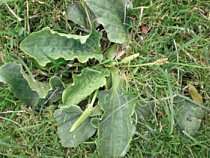
Broadleaf plantain and buckhorn plantain
Broadleaf plantain has broad, oval leaves with prominent parallel ribs. Buckhorn plantain has narrower, more lance-shaped leaves. Both form rosettes and send up leafless stalks topped with compact seedheads.
Plantain is common in compacted soil and high-traffic areas. Repeated aeration when conditions are right for your turf, along with overseeding suitable cool-season lawns, can help improve those sites. Simply removing the leaves without removing the crown and roots may not solve the problem.
Ground ivy or creeping Charlie
Ground ivy has round to kidney-shaped leaves with scalloped edges and square stems. It creeps across the ground and can root where stems touch moist soil. Small bluish-purple flowers may appear in spring.
This weed is especially persistent in shade, damp ground, and weak turf. Improving drainage, reducing excessive irrigation, pruning dense tree canopies only when appropriate, and choosing shade-tolerant turf options can make control more successful over time.
Chickweed
Common chickweed forms soft, low mats of small oval leaves and delicate white flowers. It tends to thrive in cool, moist conditions and may be most obvious in late winter, spring, or fall, depending on the region.
Do not confuse chickweed with turfgrass seedlings. Chickweed has small broad leaves and branching stems rather than narrow grass blades. It is easier to remove before it flowers and produces seed.
Henbit and purple deadnettle
Henbit and purple deadnettle are winter annual broadleaf weeds in the mint family. Both have square stems and purple-pink flowers. Henbit has rounded, scalloped leaves that clasp the stem, while purple deadnettle often has more triangular upper leaves with a purplish tint.
These weeds commonly emerge in fall, remain small through winter, and bloom in spring. Mowing may reduce their appearance, but it does not prevent seed already forming from maturing. A dense fall lawn is the best long-term defense.
Prostrate spurge
Prostrate spurge forms a flat, spreading mat with small opposite leaves, often with a reddish spot in the center. Its stems may be reddish and can release a milky sap when broken. The sap may irritate skin, so wear gloves when pulling it.
Spurge favors hot, dry, thin areas and bare soil. It frequently appears along sidewalks, driveways, and lawn edges. Mulch bare landscape beds and repair thin turf to reduce places where it can establish.
Wild violet
Wild violet has heart-shaped leaves and violet, blue, or white flowers. It can spread through seed and underground structures, allowing it to return even after top growth is removed.
Because wild violet is adapted to partial shade and can be persistent, a one-time treatment is rarely enough. Improve turf conditions where possible and expect follow-up management. In deeply shaded areas where grass repeatedly fails, a shade garden or groundcover plan may be more practical than forcing a lawn to compete.
Common Grassy Weeds in Lawns
Grassy weeds identification takes patience because these weeds share many features with desirable turf. Compare blade width, color, hairiness, growth pattern, ligules, auricles, and seedheads whenever possible. If you are uncertain, allow a small sample away from the main lawn to develop a seedhead before making a control decision.
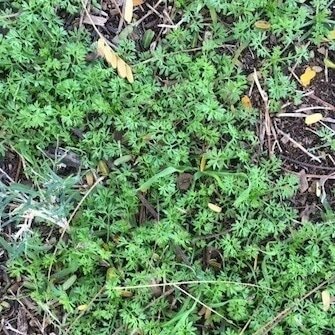
Credit: gilbasolutions.com
Crabgrass
Crabgrass is a warm-season annual weed that spreads outward in a coarse, low-growing clump. It often has wide blades compared with fine turfgrass and becomes especially visible in summer. Seedheads have several fingerlike branches at the end of the stem.
It takes advantage of bare soil, weak turf, low mowing, and hot weather. Preemergent herbicides can prevent crabgrass seedlings only when applied at the correct time for local soil warming and according to the label. They will not remove mature plants already growing.
Goosegrass
Goosegrass is another summer annual, often recognized by its flattened, whitish or silvery center. It grows in a tough, wagon-wheel-like clump and commonly appears in compacted areas, along pavement, and where mower or foot traffic is frequent.
Goosegrass often germinates later than crabgrass and tolerates compaction well. Relieving compaction, avoiding excessively close mowing, and filling thin areas can reduce recurring infestations.
Dallisgrass
Dallisgrass is a coarse, clump-forming perennial with wide blades and distinctive seed stalks. The seedheads have several branches spaced along the upper stem, with small seeds appearing in rows along each branch.
It can be difficult to manage because it is perennial and blends with turf until it outgrows it. Digging small clumps may work when the entire root mass is removed. Larger infestations may require a lawn-specific management plan because control options depend heavily on the turf species present.
Annual bluegrass
Annual bluegrass, often called poa annua, is usually lighter green than surrounding turf and may produce many small, pale green seedheads even at a low mowing height. It commonly appears in cool weather and may decline during summer heat, leaving thin patches behind.
It is especially troublesome in cool-season lawns but can appear in many regions. Avoid encouraging it with frequent shallow irrigation or chronic soil disturbance. Its management is often a multi-season process because seeds can remain in the soil.
Quackgrass
Quackgrass is a perennial grassy weed that spreads through underground rhizomes. It grows upright, tends to be coarse, and may show clasping structures called auricles near the leaf base. Pulling can leave rhizome pieces behind, allowing regrowth.
It is more common in northern lawns and disturbed soil. Because selective options are limited in many turf types, precise identification is important before treatment. Repeated removal or renovation of heavily infested spots may be necessary.
How to Identify and Manage Nutsedge
Yellow nutsedge is often mistaken for a fast-growing lawn grass. It has yellow-green leaves, grows upright faster than nearby turf after mowing, and typically has a triangular stem. It often thrives in wet, poorly drained, or overirrigated sections of the lawn.
Purple nutsedge is less common in many northern areas but can be particularly persistent in warmer climates. Like yellow nutsedge, it can produce underground tubers. Pulling the visible shoots may not eliminate these underground structures and can sometimes spread the problem if disturbed repeatedly.
Before applying a weed killer, confirm that the product specifically lists nutsedge as a target and is safe for your turfgrass. Address drainage problems, sprinkler overspray, leaks, and frequent shallow watering at the same time. Otherwise, the site may continue to favor sedge even after treatment.
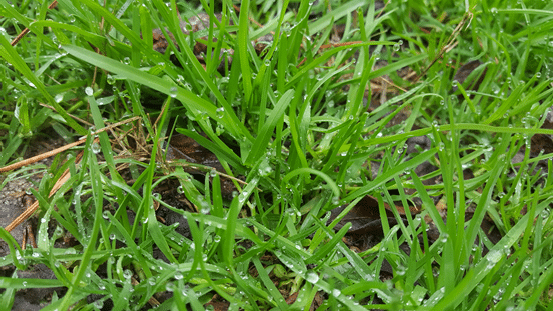
Credit: lawnchick.com
Use Lawn Conditions to Confirm Your Identification
Weeds are often indicators of conditions that weaken turf. They do not diagnose soil problems perfectly, but recurring patterns can guide your next steps.
- Compacted soil: Plantain, goosegrass, and knotweed commonly occur in paths, play areas, and lawn edges.
- Wet or poorly drained ground: Nutsedge, ground ivy, and some moisture-loving weeds are more likely to persist.
- Dry, hot, thin turf: Crabgrass, spurge, and other summer annuals often fill exposed soil.
- Shade: Ground ivy, wild violet, moss, and weak turf can be common where grass receives insufficient light.
- Low-density turf: Nearly any weed can colonize bare soil created by poor establishment, disease, drought stress, insects, or heavy wear.
- Repeated close mowing: Scalping exposes soil and reduces the lawn’s ability to compete with weeds.
Correcting the underlying issue is often more valuable than repeatedly treating the visible weeds. For example, a shady area may need a shade-tolerant grass mix, less lawn, or a different landscape planting rather than continual herbicide applications.
A Practical Process for Controlling Identified Weeds
- Confirm the weed category. Decide whether you are dealing with a broadleaf weed, grassy weed, sedge, or a non-weed lawn problem.
- Assess the scale of the infestation. Hand removal may be practical for a few plants, while widespread weeds usually call for lawn-care improvements and a broader plan.
- Choose the least disruptive effective method. Pulling, digging, mowing before seed set, mulching adjacent beds, and improving turf density may be enough for small problems.
- Use herbicides carefully when needed. Read the current product label completely. Verify the weed is listed, the product is approved for your grass type, and the timing is appropriate.
- Protect desirable plants and people. Avoid drift onto flowers, shrubs, vegetable gardens, and waterways. Follow label directions for protective equipment, application conditions, and access by children and pets.
- Repair the lawn after removal. Improve mowing, watering, soil conditions, and seeding or sodding practices as appropriate for your grass and region.
Common Lawn Weed Identification Mistakes
Credit: better-lawn-care.com
Assuming every narrow blade is grass
Nutsedge, wild onion, and some ornamental escapees can look grasslike. Check stem shape, odor, growth rate, and underground parts before choosing a control method.
Identifying from color alone
Light green patches may be annual bluegrass, nutsedge, new turf growth, nutrient stress, or uneven watering. Color is useful, but it is not a diagnosis by itself.
Applying a broadleaf weed product to a grassy weed
Many common lawn herbicides control broadleaf weeds but have little effect on crabgrass, dallisgrass, or other true grasses. Applying the wrong product wastes time and may stress the lawn.
Ignoring the lawn species
A product or cultural practice that is suitable for tall fescue may not be suitable for St. Augustinegrass, centipedegrass, bermudagrass, zoysiagrass, or newly seeded turf. Always identify your desirable grass before selecting any treatment.
Treating without correcting the cause
Weeds return when bare soil, standing water, compacted ground, unsuitable mowing, or poor grass selection remains unchanged. A healthier lawn is not weed-proof, but it is far more competitive.
Frequently Asked Questions
What is the easiest way to identify a lawn weed from a photo?
Photograph the entire plant, a close-up of the leaves, the stem base, roots if possible, and any flowers or seedheads. Include a familiar object for scale. Photos are most useful when taken before mowing and paired with notes about season, sunlight, and soil moisture.
Why do weeds grow in circles or patches instead of evenly across the lawn?
Patchy growth usually reflects local conditions. Compaction, a leaking sprinkler head, uneven shade, pet traffic, thin turf, or a buried construction area can create a small zone that favors one weed over the surrounding lawn.
Can mowing prevent weeds from spreading?
Mowing can reduce seed production for some upright annual weeds if done before seeds mature. However, it will not kill established perennials, remove underground roots or tubers, or prevent low-growing weeds from spreading.
Should I pull weeds before or after rain?
Pull weeds when soil is moist but not muddy. Roots release more easily after rainfall or irrigation, especially for plants with taproots. Avoid working saturated soil because foot traffic and digging can worsen compaction.
When should I ask a local expert for help identifying a weed?
Contact your local Cooperative Extension office, a qualified lawn professional, or a plant diagnostic service when a weed is widespread, resembles your turfgrass, returns after repeated control efforts, or may actually be a disease, insect problem, or chemical injury.